
Reader Review: A Grief Observed

We haven’t had a reader book review in a while. Today’s is from Jenny at Gracepoint Berkeley Church, who shares with us her thoughts after having read A Grief Observedby C.S. Lewis. I think it speaks for itself, so I will leave you to it.

a grief observed c.s. lewisThis book is really just that –a grief observed–the tortured grief of C.S. Lewis losing his beloved wife to cancer, compiled in a collection of his personal reflections. The book is a significant departure from his most popular works like Mere Christianity or The Problem of Pain, where Lewis is at his armchair, describing reality and life with honesty and wit, deftly persuading us of truth of Christianity. This book is different.  This is Lewis doubled over by loss and trying to make sense of life and God in the midst of it.

For someone going through loss of a loved one, I can imagine reading this book being a balm to the pain… Because it’s someone you admire deeply saying, “I’ve been there too”– not in a tidy, sanitized manner after the fact, but a real-time messy reflection full of doubts, unanswered questions and honest pain, that maybe can give voice to the chaos inside. In one heartbreaking entry, he writes of visiting all their favorite places, anticipating a heightened sense of her absence but when he doesn’t feel that, he realizes “her absence is like the sky, spread over everything.”

His more famous book, The Problem of Pain, which Lewis wrote to to provide an intellectual response to suffering, was written 20 years before A Grief Observed. Losing his wife turns out to be the crucible in which all the theory he writes in The Problem of Pain is tested. He writes in A Grief Observed, “Nothing will shake a man – or at any rate a man like me – out of his merely verbal thinking and his merely notional beliefs. He has to be knocked silly before he comes to his senses. Only torture will bring out the truth. Only under torture does he discover it himself.”

A Grief Observed is one of the few CS Lewis books I never wanted to read. But the past year and a half, I’ve attended more funerals than I ever had in my life and sat with people, most of whom younger than me, who’ve faced losses greater than anything I’ve experienced. Grief was something on my mind a lot so I finally picked up this book. And I found that it provided a window into the grief of losing a loved one, but also of losing things you can never retrieve again. It also provided a hard look at walking through difficulty as a Christian, of having one’s faith refined or demolished and remade in the fire of pain and struggle.  One quote I kept going back to was this:

“God has not been trying an experiment on my faith or love in order to find out their quality. He knew it already. It was I who didn’t. In this trial He makes us occupy the dock, the witness box, and the bench all at once. He always knew that my temple was a house of cards. His only way of making me realize the fact was to knock it down.”

If grief has been on your mind lately, maybe this book can help.

“Pain insists upon being attended to. God whispers to us in our pleasures, speaks in our consciences, but shouts in our pains. It is his megaphone to rouse a deaf world.”
 

Reading Testimonial: Narnia Visited and Revisited

It’s been a long while since we had a reading testimonial. Today’s is from Philip, a college freshman from Klesis at Gracepoint Berkeley church, and our first male guest contributer! He and I go way back, and in honor of Narnia November (have you been reading/listening?), I asked him if he remembered our Narnia Challenge from almost ten years ago. I asked him if he would be willing to write a little something for the blog.

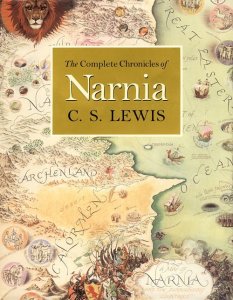
Narnia-ChroniclesHardI can remember the first time that I heard The Chronicles of Narnia. It was in the first grade when my “Uncle Mo” (Maurice from Gracepoint Austin church) had chosen the first book to read as a bedtime story. It was The Magician’s Nephew, and while I can’t remember many of the details from that time, I do remember the excitement of hearing about magic rings and crazy adventures. Though I loved reading adventure novels growing up, it wasn’t until much later however, that I read through The Chronicles of Narnia for the first time on my own.
It was during my middle school years, either 6th or 7th grade, when Emily challenged me to see who would be able to read through the entire series first. It was a simple wager with a Barnes and Nobles gift card set as the crown for the winner. I remember reading the books as fast as possible, but at the same time trying to keep a hold of the plot development in order to prove that I truly had read through the entire series! Despite quick reading, and consequently some skimming, the land of Narnia that C.S. Lewis created was mesmerizing. Eventually I won the contest, probably due to my superior intellect (but in reality just due to the fact that I had more free time), and I don’t remember what I spent that gift card on, but I know that I gained so much more from that contest.

It was actually just last year that I decided to reread the entire series with a more developed understanding of literature, and a greater level of appreciation for such thought-provoking literature. The stories had not lost their magic as I felt that I myself had simply returned the land of Narnia that I had discovered as a younger child. It is true, however, that I had my mind blown by all the meaning and the powerful messages that I had missed. Understanding the themes of redemption and loyalty, the struggle between selfish action and sacrifice, and the symbolism that I simply failed to understand before had made the books even more amazing to me. C.S. Lewis had so vividly brought to life the idea that there is a distant land to which I belong as heir to the throne because the true king, Aslan, had made it so. Aslan being the embodiment of justice and right, a powerful terrifying lion, and yet caring and merciful enough to die in order to redeem Edmund, that was powerful for me. The adventures that were shared through loyalty and a striving for good and what Aslan would want, those were adventures that I wanted. I cannot express enough how The Chronicles of Narnia has impacted me, though at first I saw them as “only” children’s stories.

I didn’t know the fuller story of Philip’s history with Narnia. I just remember trying, all those years ago, to think of a way to motivate Philip to read, and even being willing to suffer the humiliation of losing the challenge (I did actually try, but Philip’s superior intellect won out!). It tickles me to read of how he too has experienced what so many of us have as we read and read the series after childhood — that our eyes open to the deeper spiritual truths embedded in what seems to be “only” a child’s fairy tale.

I’m reminded of a couple of my favorite C.S. Lewis quotes about reading:

“Some day you will be old enough to start reading fairy tales again.”

“A children’s story that can be enjoyed only by children is not a good children’s story in the slightest.”

This has been my personal experience with The Chronicles of Narnia, as well as with other great stories for children. I’m especially looking forward to rereading The Horse and His Boy, as I have now tallied six people who count it as their favorite of the series, and for compelling reasons!

Youth Book Review: A “Wonder”-ful Companion Novel

It’s been a spell since our last Youth Book Review, which was a smash hit, and lots of people ran out and read Wonder by R.J. Palacio. Since writing the novel in 2012, Palacio has written several shorter pieces that were previously only available in e-book format. Earlier this year, all three “chapters” were published together in the form of Auggie & Me.

If you’ve already read the e-books, you’ve already read Auggie & Me. 🙂  Just to clarify, this is *not* a sequel. There’s a whole ‘nother thing that has emerged in the book publishing world, in the form of the “companion novel”. It’s set in the same world, and in roughly the same time period as the events of the original novel, but tells the story from another character’s point of view, or the fuller story of a supporting character who was in the original book, as a sort of parallel story. Its close cousins are the 0.5 story (prequel), or the 1.5 story (the story published as an e-book while you wait for book 2 to come out in a series). But I digress.

Today’s book review comes from a 7th grader from our Gracepoint Los Angeles church. As she is the sole 7th grader at our LA church plant, her identity is not a secret. Nevertheless, because pen names make everything more fun (see: Mr. Sketch), she writes under the nom de plume Number Two, which is a literary allusion to Pencilla’s code name in The Mysterious Benedict SocietyGet it? Number Two…Pencilla?

Number Two’s natural ebullience* comes through in her review, and it makes me wish that I had added my name to the Book Waiting List for the book before setting it loose among the Bibliopolis middle school patrons!

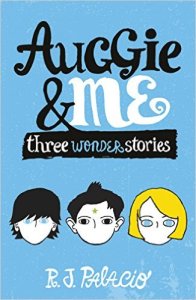
auggie and me coverI wanted to read Auggie and Me by R.J. Palacio because I absolutely loved Wonder. When I saw that there was another book relating to it, I immediately wanted to read it. In the three novellas, Auggie is more of a side character than the main man. The three main characters are Julian (the bully), Christopher (Auggie’s old best friend), and Charlotte (Auggie’s “welcome buddy”). Each story is told from one of their perspective.

The first story is “The Julian Chapter”. If you have read Wonder, you know how Julian is like. He’s the kind of kid who doesn’t like changes, so he tries to turn things back to normal by making Auggie feel ashamed of himself, in hopes of him leaving the school. In Wonder, I really didn’t like Julian at all and he just made me so mad. But in this chapter, Julian finally comes to his senses and realizes what he has done to Auggie. His big realization comes when he says that sometimes we hate the things that we’re afraid of. For him, it’s Auggie. Over the summer after thinking a lot, he finally decides to apologize to Auggie and wants to start things over with him. He makes a precept that says: “Sometimes it’s good to start over.” Towards the end of this chapter, I kind of felt for him more and could see what he was going through.

The second story is called “Pluto”. It kind of peeks into Auggie’s life before the events of Wonder, when he still had his best friend Christopher, before he moved away. When Chris moved, he and Auggie slowly grew apart. Before reading this I didn’t really know how Chris was like but as I continued to read it, he became a very relatable character especially since he is in middle school. When he went to his new school he realized that it’s hard to have a friend that looks so different. So Chris decides to find some normal friends who people won’t stare at all the time and ignores Auggie for a little while. But then something happens (you’ll have to read it to find out what!) and Chris realizes that having a true good friend is worth the extra effort.

The third and final story is “Shingaling”. It’s based on the perspective of Charlotte Cody. She is the “welcome buddy” for Auggie and is kind of known as a “goody-goody”. I remember I didn’t like her that much in Wonder because she seemed “too nice”, but as she enters middle school she struggles with popularity and friend problems and I was able to understand her a little better. As she continues to try to help Auggie out and be a good friend to him, she encounters problems of her own (which you’ll find out about when you read!). Through all this she realizes that doing what is right is not always popular. This novella was probably my favorite because I was able to relate to it most.   

As you can see, through the three characters’ different perspectives you get to see how they feel about Auggie. I really liked this book, because it described some things that I would’ve never known was going on in their lives. After I finished reading, I felt like I finally understood everyone’s background and was able to understand more of them rather than making quick judgments by the little that I heard in the previous book. I would recommend this book to “Wonder lovers” or anyone in 6th grade and up**. This book shows that being a good friend is hard but is worth it. And even though you may encounter problems, just stick through and if you have a good friend to rely on it will make it so much more easier. Like Charlotte says: “It is not enough to be friendly. You have to be a friend.”

Have you read Auggie & Me, or any of the stories separately? If so, which is your favorite? 


*ebullience (n): the quality of being cheerful and full of energy; exuberance.

**All of the Bibliopolis middle schoolers who have read this thus far say that it’s definitely for middle and up. I trust them!