I realize my “photo” for Wordless Wednesday is full of words. But trust me, it’s worth it!
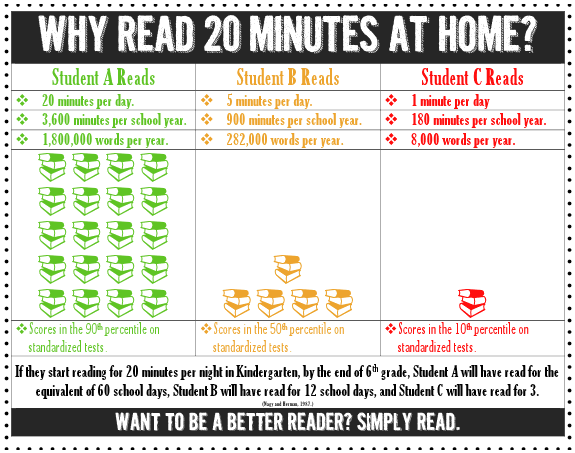
Did you ever have a “____ minutes a day” goal for reading when you were growing up? Share your thoughts on the chart in the comments below.

I realize my “photo” for Wordless Wednesday is full of words. But trust me, it’s worth it!
Did you ever have a “____ minutes a day” goal for reading when you were growing up? Share your thoughts on the chart in the comments below.
In my previous post, I gave three tips on how to “get” your child to read. Today I want to focus on what WASN’T on my list!
Again, before you read on, make sure you’ve watched the video from Drive by Daniel Pink, which you can find in last week’s post. Today, you’ll find that what DIDN’T make it onto my list ties in with all three principles of autonomy, mastery, and purpose. Test yourself to see if you can find the connections. 🙂
#1 Paying your child to read. Whether it is with money or other rewards, please try to resist the urge to bribe your child to read. I realize that your child will respond to money, or other incentives, and may end up reading more, but it will likely NOT result in genuine love for reading.
Let’s take the example of paying your child to do chores. Learning how to manage money is a good thing. And doing chores to understand that we all contribute to the family and home is also a good thing. And what do you know? Your child does the chores in order to get the money! But say you stop paying them. How likely is it that your child will continue to do the chore?
If your goal is for genuine love of reading, bringing in an extrinsic motivation will be a deterrent. As cheesy as it sounds, you really want your child to experience the reading as its own reward! The only situation in which I would say an external reward makes sense is if the reward is MORE BOOKS! 🙂
You might be saying, “Hey, didn’t you have a reading challenge with the 7th & 8th grade girls this summer, where if they read 30 books, they got to go with you to Monterey House for a reading camp? Isn’t that “paying” kids to read?” Why yes, I did (future post to come), but guess what we did at the reading camp? Not even kidding, we READ…and we read a lot. And we wrote in our writer’s notebooks, and made blackout poetry. So I think it falls under the category of reading 30 books being an accomplishment that was its own reward. And I rewarded them with…more reading!
#2 Forcing your child to read ____ minutes/hours every day. Yes, it’s true that reading 20 minutes a day can have a powerful impact on your child’s education. [Where did you get that statistic, Emily? Don’t leave us hanging! Well, stay tuned because it shall be revealed tomorrow!]. HOWEVER, you don’t want to FORCE your child to sit down and read. If your child is a reluctant reader, the worst thing you could do is to force them to read. That will only reinforce reading as a dreadful activity in their mind. That will put reading on the same level as practicing piano, which most kids will do anything to get out of!
Again, you have to remember your goal. If your goal is for your child to develop an actual love of reading, you want to create as many positive associations and experiences around reading for your child as possible!
(Just in case it’s not perfectly obvious, any combination of #2 with forcing them to read a specific book you have chosen would also be…pretty dreadful and counter-productive to your ultimate goal.)
#3 Requiring your child to write a book report for every book they read. Like the now-famous quote/phrase from James Kim that Pastor Ed Kang used in his Perfectionism III message a couple of weeks ago, you’ll end up “ruining both things.” The both things in this case being reading and writing*! Think about the books you love(d). Did you write essays about them? Teachers, and parents who have their kids write book reports, say, “How else can you have them prove they read the book?” Oh my, oh my, don’t get me started. There are so many ways to “prove” we have read a book, but a book report isn’t one of them. You and I know (some of you know better than I do) that you don’t have to have READ a book in order to WRITE A BOOK REPORT that would get an “A” grade from a teacher!
I’m all for having rich text-based discussions about a book. I’m for really different kind of written projects that involve a lot more critical thinking. I’m for creative projects that require a child to make connections, and really enjoy the process of communicating something important about the book.
And trust me when I say that if your child really read the book they chose, they won’t be able to help but talk about it, tell other people to read it, and maybe even pick up another book to read because it’s similar in theme, or someone who liked their book recommended it, or because it is by the same author. It’s amazing really.
Safe-space confessional time: Have you done any of the above? Was it successful? Did it backfire? Did you have any of them done unto you? How successful was it?
*About writing: kids have so many things they want to write about. 99% of them don’t involve the canned book report!
You’ve noticed by now that the questions the parents here at Gracepoint Berkeley church ask me are pretty much permutations of the same central question. But today I want to focus on the “getting” your child to read. But before you read on, be sure to watch the video from the post about Daniel Pink’s book Drive. You’ll see that my list today focuses mostly on the principle of “autonomy.”
Here is my super long list of ways to get your child to read:
#1 CHOICE. Allow them to choose what they read. If you want them to develop a love for reading, they need to read what they love. Telling them, “Read this. It’s a good book.” will rarely work. Consistent with the human condition, most (if not all) children, especially teens, will not want to read it simply because you recommended it. EVEN if they were thinking of reading it before you said anything. (Even when kids ask me what they should read, I usually give them a stack of books to choose from.)
Resist the temptation to say, “That’s too easy for your grade level” or “You should be* reading _____ by now.” Your child is forced to read books with his or her class, and their teachers are choosing books they deem appropriate for their developmental stage. If reading a book you think is “too easy” for your child gets him or her hooked on reading, maybe even FOR LIFE, it’s totally worth it, wouldn’t you say?
Your child is apt to read more if they feel confident as a reader, so give them the time and space to develop their confidence through reading what they choose. Trust me that in time, they’ll push themselves to read more challenging books. It’s in our nature (future post to follow).
#2 FLOODING. As in a “book flood.” One of the reasons I invested hundreds of dollars (if not more) in my classroom library was because I firmly believe that if kids are surrounded by reading materials of all genres, they are more likely to find something they like, and therefore more likely to read it. What this means for you doesn’t necessarily mean spending hundreds of dollars on books! It might mean making trips to a local bookstore, used bookstore, and/or library, and making that a “thing” you do together.
As a side note, this is the reason I have worked pretty hard at creating a space kids want to be in over at Bibliopolis. I want them to love being there, and definitely want them to be surrounded by books so they’ll always associate books with something special or even slightly magical, or at the very least, something positive!
#3 MODELING. The more your child sees YOU reading for pleasure, they will see reading as a pleasurable activity. You know by now that your kids notice everything you do and say. Sometimes they can even imitate the way you do and say it! This means that they are aware of your relationship (or non-relationship) with books. Studies around kids and technology reveal that one of the biggest frustrations they have is that their parents are hypocrites when it comes to technology.
The same goes for reading. Your kids know if you’re just telling, or even forcing, them to read, but you never do it yourself. Even though we’re all super busy, please believe me when I say that developing your own reading life, and sharing that with your kids, is one of the most powerful ways you can influence your child to be a reader.
You don’t always have to read aloud to your child, which some feel too pressed for time to do regularly. But what I’m suggesting is a win-win! You can read whatever you’ve been meaning to read** — fiction, non-fiction, apologetics, biographies, poetry — and you can spend time with your kid while they’re reading their book too.
And there you have it. That’s my list. My teaching colleagues often asked me how I got my students to be such book nerds. And I always tell them the above three things. I let my students choose what to read, out of a gazillion books that they have access to right there in the classroom, and I constantly talk about the variety of books I’m reading, regularly doing book talks, asking them about what they’re reading, encouraging lively conversations and even arguments around books, and making it a priority to set aside “sacred time” for silent reading all together (including me) every day.
What strategies or practices have you tried to “get” your child to read? How did you become a reader yourself? Looking forward to sharing our reading successes!
*We impose our “should be’s” on others!
**Try to read something that’s in physical book form.
 Acts2 Books